
Idylease.org Expands Public Access to the History and Restoration of a 1903 New Jersey Highlands Health Resort
Idylease.org has expanded as a public-history resource for Idylease, a historic 1903 health resort in the New Jersey Highlands. The renewed website brings together archival research, walking-tour resources, turn-of-the-century photography, video, restoration documentation, and historical writing on one of the region's rare surviving resort-era landmarks. The site is maintained by Richard Zampella, owner and operator of Idylease, whose broader work as a documentary producer and editor is documented at www.richardzampella.com.
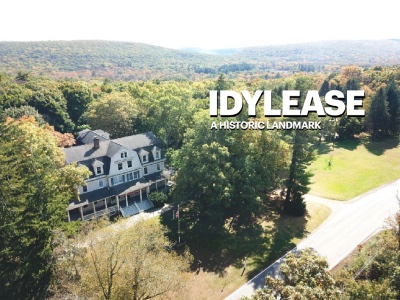
NEWFOUNDLAND, NJ – July 4, 2026 – Idylease.org is being expanded as a public-history resource for Idylease, a historic 1903 health resort in the New Jersey Highlands region of northwestern New Jersey.
The renewed website brings together archival research, restoration documentation, walking-tour material, photography, video, historical writing, and blog content connected to the property's more than 120-year history. The goal is to make the history of Idylease more publicly accessible while documenting the underlying work of restoration and stewardship required to preserve the site.
Idylease opened its doors on New Year's Day, 1903. The idea for the property began in 1902, when the Newfoundland Health Association was formed under the direction of Dr. Edgar A. Day. From the beginning, Idylease was not conceived as a conventional hotel. It was intended as a place where people came to restore themselves.
Early descriptions of Idylease presented it as a modern health resort. The term carried a different meaning than it does today. It referred to a place located 38 geographic miles from New York City and organized around rest, fresh air, regular hours, wholesome food, exercise, hydrotherapy, massage, baths, and medical care. Many who came believed that the mountain air itself was part of the cure.
The building stands high on a hillside, one thousand feet above sea level, looking out over the surrounding woods and mountains. Wide porches wrap around the structure. Long balconies open from the upper floors. Guests originally arrived by train at Newfoundland, where a horse-drawn carriage met them for the climb into the hills. The fare was twenty-five cents per person and five cents per bag.
Idylease also belongs to the railroad history of Newfoundland. The same Newfoundland train station that served guests arriving for Idylease later became widely recognized as the central location in the 2003 Miramax film "The Station Agent," starring Peter Dinklage. For Idylease, the station was not scenery. It was part of how the resort functioned, connecting the cities to the foothills of the Ramapo Mountains.
Nothing about Idylease was incidental. The landscape was part of its purpose. The daily routine was part of its purpose. The building itself was part of its purpose. The broad piazzas, sun parlor, dining room, reception hall, conservatory, treatment rooms, and surrounding grounds all served the same idea: health could be cultivated through environment, order, and care.
The estate was also built to function. A working farm supplied food. Outbuildings supported daily operations, including a barn, blacksmith shop, pump house, ice house, and later a power plant. Idylease was not only a building on a hill. It was a self-contained estate.
After Dr. Day's death in 1906, his nephew George A. Day continued to operate the inn for many years. In time, Idylease passed out of the Day family and was purchased by Dr. Daniel Edgar Drake, under whose direction the property began to change for a new generation of patients.
Over the years, Idylease received guests whose lives elsewhere were tied to industry, government, war, finance, journalism, education, language, and social reform. Thomas Edison stayed at Idylease while working on mining experiments in nearby Franklin and Ogdensburg. Mary Teresa Norton, one of the first women to serve in the United States Congress, was a regular guest in the late 1920s. Horatio Collins King, a Civil War veteran and Medal of Honor recipient, also passed through its doors.
Other names associated with the property include Joseph French Johnson, William B. Hanna, David Banks Sickels, Victor Harrison-Berlitz, Grace Abbott, and others. At Idylease, they entered the same routine as everyone else. They came to the mountain for a while, then moved on.
Idylease remained.
In 1928, Edison returned to Idylease and oversaw the installation of electrical wiring and a power plant that allowed the building to generate its own electricity. Until then, the building had been lit by gas. Each evening, lamps had to be lit by hand. Each morning, they had to be turned off. Electricity changed the life of the building. Flame gave way to the light bulb. Switches replaced matches. Wires ran through walls and ceilings. Poles carried power through the trees from the generating plant back to the house on the hill.
The property was designated West Milford's first local historic landmark in 1988. Richard Zampella, owner and operator of Idylease, has long maintained that the property is eligible for listing on the National Register of Historic Places. In a News 12 New Jersey interview, Zampella described Idylease as one of the last surviving examples of the resort architecture that once helped define northern New Jersey as a recreational destination connected to the railroad.
Zampella has written, "History is not merely the preservation of what happened. It is the moral act of making the past answerable to truth, so that what has been entrusted to us is not lost, distorted, or abandoned."
That principle guides the continuing work at Idylease.
For Zampella, Idylease was never simply a historic structure. It was the landscape of childhood. It was the place where he watched his father, Dr. Arthur Zampella, practice medicine and create a small community within its walls. His father believed in dignity and care, and Idylease became one of the places where that belief took physical form.
Zampella later left those woods and built a life elsewhere. He lived in Jersey City and Manhattan, worked for years in New York hospitality institutions including the Rainbow Room, Le Cirque, and The Plaza Hotel, and later became a documentary producer and editor whose work has aired on public television. More information about his broader work is available at www.richardzampella.com.
In April 2016, Zampella returned and assumed stewardship of Idylease. The work was not simply a matter of restoring rooms or preserving architectural details. It was a matter of remaining answerable to the place itself, to what it had been, what it became, and what had been entrusted to it over time.
The renewed website reflects that work. It includes material on the building's origins as a health resort, its architectural and medical history, notable guests, restoration work, family stewardship, and the surrounding land. It also supports public-history programming connected to the property, including free annual walking tours conducted by Zampella.
Those tours give visitors an opportunity to learn about Idylease's beginnings as a health resort, its later medical history under Dr. Arthur Zampella, its relationship to the railroad and the New Jersey Highlands, and the restoration work that has taken place since Zampella returned to the property.
The restoration of Idylease is not being treated as a single unveiling. It is an ongoing process of repair, research, documentation, and care. The website presents the property not only as an architectural landmark, but as a working historic place shaped by health, landscape, medicine, family, and time.
"People see a house on the hill," Zampella said. "They do not always see the field that has to be crossed to get there. The website is one way of making that work visible."
Idylease remains significant because of what passed through it and what still remains there: the early twentieth-century belief in air, landscape, hydrotherapy, routine, and rest; the later history of medical care under Dr. Arthur Zampella; the forest his family worked to preserve; and the continuing responsibility of keeping the place from being lost, distorted, or abandoned.
Idylease.org will continue to expand as additional archival material, photographs, restoration updates, videos, and historical research are organized and made available.
For more information about Idylease, visit www.idylease.org. For more about the work of Richard Zampella, visit www.richardzampella.com.
About Idylease
Idylease is a historic 1903 health resort located in the Newfoundland section of West Milford, in the New Jersey Highlands region of northwestern New Jersey. Built in 1902 and opened on New Year's Day, 1903, Idylease was originally operated as a modern health resort offering rest, fresh air, hydrotherapy, massage, baths, and medical care. The property was designated West Milford's first local historic landmark in 1988 and remains under the stewardship of Richard Zampella.
CONTACT: